Description
Outdoor-ready 360 J biphasic defibrillator with full monitoring and network integration
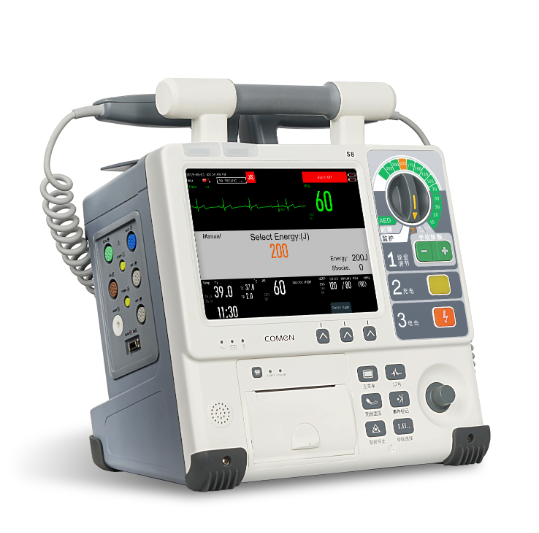
The Comen S8 Defibrillator Monitor is engineered for emergency, EMS and hospital first-response settings, offering robust performance in harsh environments and full cardiac support capabilities. With energy selection up to 360 J and advanced Biphasic Truncated Exponential (BTE) waveform technology with automatic impedance compensation, it ensures effective defibrillation even in high-impedance and challenging patients. The device features IP44 ingress protection, shock-resistant housing and a large-capacity lithium battery supporting more than 420 discharges per charge for reliability in field use. A built-in 80 mm thermal printer, 240-minute voice-record storage, Wi-Fi/ethernet connectivity and HL7/HIS integration enable streamlined data management and networked workflow for first-aid teams.
Key Features & Technical Highlights
• High-energy defibrillation up to 360 J with impedance-compensated BTE waveform — maximises shock effectiveness in difficult cases.
• Rugged design with IP44 rating and drop/impact resistance — supports reliability in outdoor, EMS and transport environments.
• Full-feature monitoring including 12-lead ECG option, SpO₂, EtCO₂ and NIBP — brings comprehensive patient assessment to the rescuer.
• Large-capacity battery (>420 shocks) and fast charging — ensures readiness for prolonged field missions.
• Networking capabilities with thermal print output, voice-record storage and HL7/HIS compatibility — enables data capture, review and integration into hospital systems.
Workflow & Clinical Use
In emergency or pre-hospital settings, the S8 enhances operational readiness by offering a fully capable defibrillator-monitor built for rapid deployment and data connectivity; clinicians gain from integrated monitoring, patients benefit from high-quality shock delivery even under challenging conditions.