Description
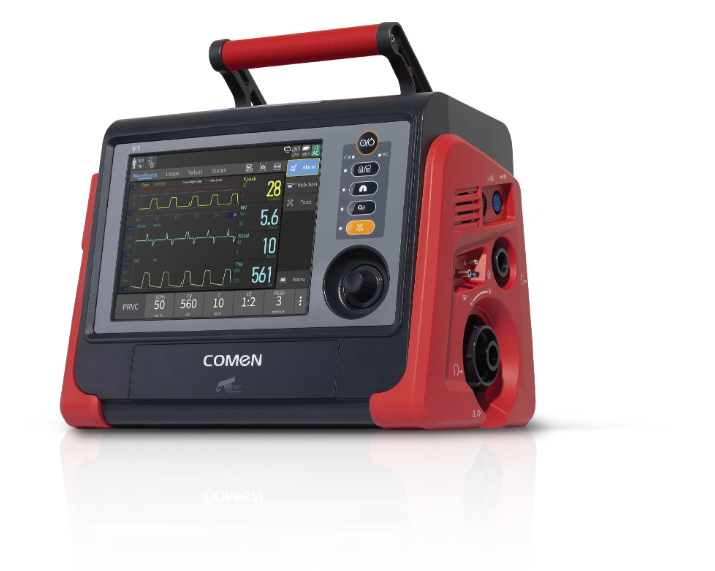
Rapid-deploy turbine ventilator built for extreme environments and full-spectrum patient support
The Comen V1/V1 Pro Emergency & Transport Ventilator is purpose-designed to bring ICU-level respiratory care into the most demanding transport, field or intra-hospital settings—supporting neonatal, pediatric and adult patients seamlessly. Its rugged turbine-driven air delivery architecture eliminates reliance on central gas infrastructure, allowing high pressure, full-mode ventilation during ambulance transfer, helicopter airlift or remote rescue. With operational certification across extreme temperatures, high altitude and crash-impact scenarios, the unit delivers medical-grade reliability in harsh environments. Integrated intelligent algorithms optimise patient synchrony (-Cycle), while advanced monitoring, weaning indices (such as RSBI, P0.1) and full-range ventilation modes ensure clinical precision, safety and continuity of care from transport through ICU.
Key Features & Technical Highlights
• Turbine-driven system eliminating central air dependency — enables true portability and field-use reliability.
• Engineered for extreme environments (-15 °C to +50 °C, up to 7,670 m altitude, IP-rated housing, drop/crash-tested) — ensures uninterrupted operational performance under challenging conditions.
• Lightweight, ergonomic design (~6.5 kg) with dual-battery runtime >10 hours and hot-swappable battery — maximises mobility and reduces downtime.
• Full-spectrum ventilation modes (including neonatal invasive/non-invasive) and high pressure capability (up to ~65 cmH₂O) — provides comprehensive support across patient populations.
• Intelligent synchronisation algorithms (iV-Cycle), real-time oxygen consumption tracking, rugged monitoring tools — enhance patient comfort, clinician efficiency and safety in transport-to-ICU continuity.
Workflow & Clinical Use
In emergency response, intra-hospital transfer or remote care scenarios, the V1/V1 Pro streamlines workflow by combining portability with full ventilation span and rapid set-up; patient comfort and safety are enhanced via intelligent synchronisation and robust environmental resilience, while clinicians benefit from seamless transition into critical-care settings without device change.